

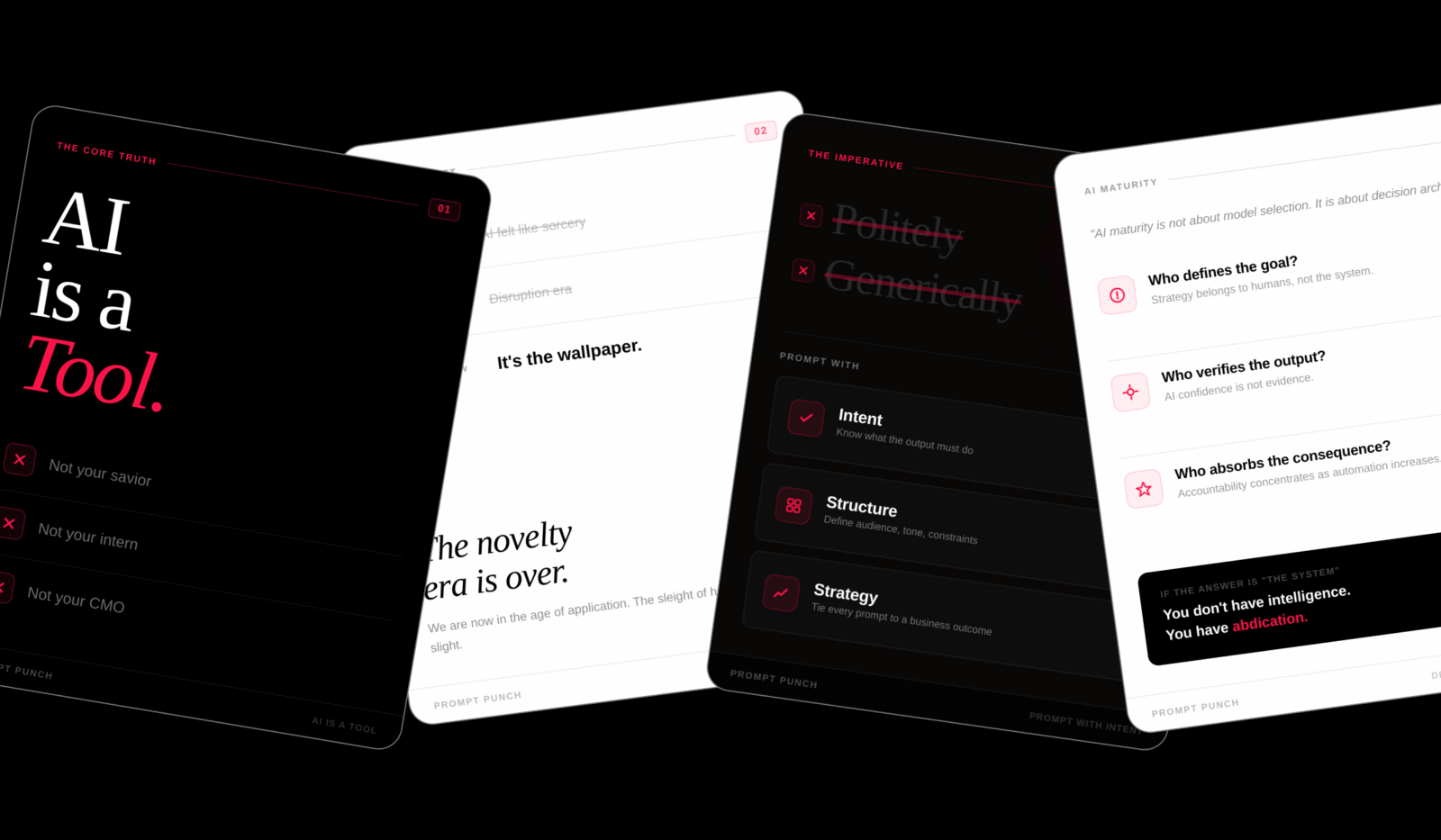

AI is a Tool. Prompt Punch.
In the age of AI, it is more critical than ever to control your brand’s narrative. Today, everyone has access to powerful AI tools, but only expert creatives can use these tools to build and enhance brands in ways never before possible. Because while AI will help you, you must remember…
AI is not your savior, intern, or CMO.
It’s only a tool. A democratized one.
And in a world where everyone has access to Prometheus’ fire, the advantage shifts back to the people who know how to burn brightest.
Not “prompt politely.”
Not “prompt generically.”
Prompt with intent, structure, and weaponized strategy.
The novelty era is no more. We are now in the age of application.
Funeral for a Magic Trick
In 2023, AI felt like sorcery. In 2024, disruption. Now, it’s the wallpaper.
The sleight of hand seems only slight now.
LLMs are probabilistic (and problematic) systems. They predict the next most likely token, synthesize patterns, and remix information at scale.
They do not:
- Interpret nuance in regulatory language
- Carry fiduciary responsibility
- Sense the scale of a strategic sidestep
As Ethan Mollick has noted, AI is “a tool for thought.” Satya Nadella calls it a “copilot.” Sam Altman describes it as a “capability amplifier.”
Notice the pattern (just as AI would): amplifier. Copilot. Tool.
Not strategist, executive, or accountable party.
The companies winning right now are not the ones generating the most AI output, but the ones applying the most disciplined thinking around it.
The Myth of the Autonomous Solution
There is a persistent fantasy circulating in boardrooms and marketing Slack channels: that AI systems are self-directing engines of insight.
They are not.
Large language models (LLMs) do not reason. They predict.
They do not understand context. They approximate it.
They do not define objectives. They optimize against the ones we give them.
Pedro Domingos wrote in The Master Algorithm that machine learning systems are only as sound as their objective functions. The problem is rarely the algorithm. The problem is what we ask it to optimize.
If your strategic inputs are vague, your AI outputs will scale that vagueness.
Ambiguity, multiplied.
This is why AI maturity is not about model selection. It is about decision architecture.
Who defines the goal?
Who verifies the output?
Who absorbs the consequence?
If the answer is “the system,” you do not have intelligence. You have abdication.
From Experimentation to Institutional Competence
Most organizations are still in the experimentation phase.
Marketing uses AI to draft blogs.
Sales automates outbound sequences.
HR accelerates job descriptions.
Product teams prototype features in hours instead of weeks.
These are useful accelerants. They are not yet capabilities.
True AI advantage emerges when use becomes:
- Defined
- Repeatable
- Governed
- Measured
In other words: institutional.
1. Start With the Business Constraint
Not “How can we use AI?”
But:
- Where are we losing time?
- Where are we losing margin?
- Where are we losing authority?
- Where are we exposed to risk?
AI should be applied to friction, not fascination.
If it does not tie to revenue, cost, risk, or differentiation, it is a hobby.
2. Design the Human-in-the-Loop System
Harvard Business School research has shown that AI-assisted professionals outperform both unassisted humans and AI-only systems in many knowledge tasks.
The model that wins is hybrid.
AI drafts.
Humans interrogate.
AI summarizes.
Humans synthesize.
AI proposes.
Humans decide.
This is not inefficiency. It is control.
3. Embed Governance Early
Over-automation erodes:
- Brand voice
- Legal defensibility
- Regulatory compliance
- Customer trust
In cybersecurity, healthcare, and finance, the margin for error is narrow. An unverified hallucination in a whitepaper is not a stylistic issue. It is reputational exposure.
Mature organizations implement:
- Prompt documentation standards
- Fact-checking requirements
- Data privacy boundaries
- Approval checkpoints
AI without governance is scale without guardrails.
When Prompting Goes South
Let’s be adults.
Below is a deliberately weak prompt for the next paragraph of this article.
The Poor Prompt
Write a paragraph about why companies need guardrails when using AI.
In today’s rapidly evolving digital landscape, organizations must implement guardrails when adopting artificial intelligence solutions. By establishing clear guidelines, governance frameworks, and best practices, companies can ensure responsible AI usage while maximizing efficiency and robust innovation. Guardrails help mitigate risks, enhance transparency, and foster trust as businesses navigate their AI transformation journey.
It sounds professional.
It says nothing.
“Rapidly evolving digital landscape.”
“AI transformation journey.”
“Enhance transparency.”
This is not strategy. It is beige.
Now watch what happens when the instruction changes.
The Strategic Prompt
Write a paragraph for cybersecurity executives arguing that AI guardrails are a competitive necessity, not just a compliance requirement.
Tone: direct, precise, no buzzwords.
Include one reputational consequence and one operational safeguard.
The Optimized Result
Guardrails are not about slowing AI adoption. They are about protecting competitive advantage. In regulated industries, a single unverified AI-generated claim can trigger regulatory scrutiny, erode client trust, and introduce contractual exposure. Governance is not bureaucracy. It is competitive hygiene. Documented prompts, human review layers, and structured approval workflows ensure that AI amplifies institutional intelligence instead of diluting it.
Same model.
Different architecture.
The first paragraph fills space.
The second establishes stakes.
The difference is not artificial intelligence.
It is editorial intent.
What Happens Between Prompt and Publish
Strong prompting is the beginning. It is not the safeguard.
Even the optimized paragraph above would not go live without process.
Institutional maturity requires structure around the output.
1. Prompt Documentation
Every strategic prompt is defined by:
- Audience
- Objective
- Constraints
- Tone
- Source expectations
- Intended business outcome
Prompts are designed, retained, and reviewable. That makes them auditable and repeatable.
2. Voice Alignment Review
AI drafts are never shipped raw.
Each piece undergoes voice alignment to ensure:
- Sentence rhythm matches brand standards
- Claims are precise and defensible
- Tone is assertive but not theatrical
- Messaging reinforces positioning
Generic phrasing is rewritten. Inflated language is removed.
3. Fact Verification Protocol
All references are validated.
All statistics are sourced.
All technical claims undergo subject matter review.
AI-generated confidence is not evidence.
4. Multi-Layer Approval
Before publication:
- Strategic alignment review
- Subject matter validation
- Brand voice approval
- Executive sign-off
AI assists. Humans own.
Accountability does not disappear because automation increases.
It concentrates.
Preventing Brand Dilution in the Age of Abundance
The greater risk of AI is not inaccuracy.
It is homogenization.
Generative systems optimize toward the statistical middle. Without strong human direction, they produce competent, neutral, and indistinguishable language.
Average voice and framing with no ideas.
Brands are not built on average.
To protect distinctiveness:
- Take a position. Neutrality is forgettable.
- Prioritize specificity over generality.
- Maintain editorial friction. Speed is not always strength.
- Measure brand alignment, not just output velocity.
- Treat AI as augmentation, not authorship.
The organizations that protect their voice will not publish the most content.
They will publish the most credible content.
Measurement Is the Difference Between Hype and Strategy
If AI adoption is strategic, it must produce measurable advantage.
Track:
- Production velocity
- Organic performance
- Engagement depth
- Lead influence
- Conversion impact
- Cost per asset
If outputs increase but outcomes do not, you are automating activity.
Not value.
As Erik Brynjolfsson’s research suggests, gains from AI accrue to those who redesign workflows around it — not those who simply deploy it.
Deployment is easy.
Redesign requires discipline.
In the Right Hands
An experiment by design
Joe DePalma, our co-founder, ran a clean experiment.
He gave the same design brief to Claude, OpenAI, and Figma Make.
The results were passable upon a squinted glance but unfinished in ways that mattered: stray black whisker lines, missing margins, logos drifting without gravity.
Then Joe did the same assignment.
His version held. Not because he rejected the tools.
Because he filtered them.
An experienced designer does not merely generate. He selects.
Joe grasps composition, hierarchy, brand nuance, negative space, visual tension, audience psychology. He sees what to discard before others notice what’s wrong. He sees the world in hex codes and knows every shade of color theory.
He knew what to cut.
He knew what to refine.
AI generates options.
Experience determines which option survives.
Powerful tools in the hands of expert creatives deliver outcomes that were never before possible.
The artisan decides what lives.
The Bukowski Effect
Charles Bukowski noted that awful writers inspired him. He’d put down the book and mumble:
“Oh. Right. I’ve got this.”
Not cruelty. Calibration.
He’d bemoan AI while blessing the bots for reminding everyone why they prefer his stuff.
You scroll past endless grammatically perfect, structurally clean, and intellectually hollow AI-generated posts.
Hedged confidence.
Abstract optimism.
Bloodless competence.
The stanzas of sameness sharpen your senses.
And any worthwhile writer knows:
“It’s my turn now.”
The machine raises the floor.
The ceiling (and Sistine Chapel) are up to you.
The Competitive Reality
Your competitors have access to the same models. Your customers do too.
Access is not the differentiator. Ideation and execution
The organizations that win in this cycle will:
- Architect prompts with intent
- Institutionalize guardrails
- Protect their voice
- Verify their claims
- Measure their outcomes
In a market flooded with output, clarity is currency. And discipline becomes brand equity.
The fire is everywhere. But smoke signals won’t save you.
The future favors those who know the nearest exit.